Frances, Care Coordinator, reports on a very sad rescue operation
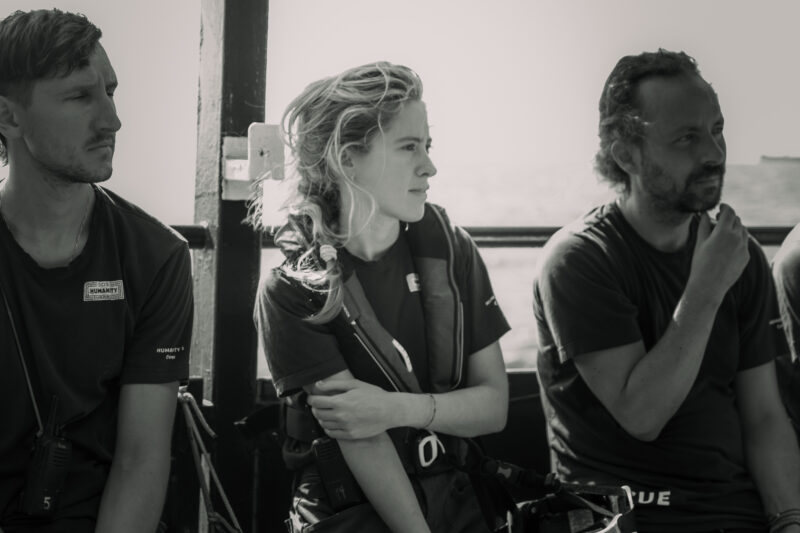
Frances is Care Coordinator and responsible for overseeing the care of the survivors rescued. She leads the Care Department and is part of the Head of Mission Team on board Humanity 1. Frances has worked with SOS Humanity since 2023. Here she reports on a very sad rescue operation.
On 3rd October 2013, 368 people drowned off the shores of Lampedusa, a small Italian island in the Central Mediterranean Sea, in one of the worst shipwrecks in European memory. Twelve years later, on Friday 3rd October 2025, I am on board SOS Humanity’s rescue vessel, the Humanity 1, 60 nautical miles south of Lampedusa. The weather has been too rough for departures of small boats from Libya or Tunisia, but we are anticipating some crossings during the weekend when the weather is forecast to be much calmer.
It is 15.00 in the afternoon when out of nowhere, an overcrowded rubber boat appears amid the frothing waves, then disappears. The weather conditions are very dangerous – the waves are three-metres high, and with the distressed boat just hundreds of metres in front of our ship we have little choice but to opt for a risky close contact rescue operation. Such a manoeuvre is dangerous, because when a small boat is alongside the large mothership, people risk being crushed in the gap between the two vessels or being sucked underneath during the rescue.
Extremely difficult conditions
With no time to prepare, we find ourselves thrust into a situation we have little control over. Amidst the screams of the people onboard, we shout into the wind as the deck team throws lines to the outstretched hands. The mother in the middle of the bodies tangled together screams the loudest: she is carrying a small child with severe fuel burns. Suddenly, a young man clings in desperation to a painter line from the ship. Thrust backwards and forwards by the waves, the gap between the two vessels widens as he straddles the two. He quickly disappears underneath the waves – the rescue team has no chance to help him.
Medical evacuation needed
The more people we pull up the ladder onboard, the more we understand this is a mass casualty situation and activate our emergency medical response. As stretchers move back and forth across the deck and the clinic fills with unconscious bodies, we start CPR immediately and request medical evacuations from the competent authorities.
The Italian Coast Guard and Maltese military join forces to offer the evacuation of ten persons; the two most critical by Maltese helicopter, and eight others by Italian Coast Guard vessel alongside Humanity 1. But when help finally arrives, multiple attempts by the coast guard vessel to come alongside our ship fail. The waves are simply too strong. Over the next hours they escort us closer to Lampedusa where they will attempt the evacuation closer to shore.
Helicopter evacuation impossible
Inside the clinic, we wait anxiously for the helicopter to arrive: the people pulled on board Humanity 1 are suffering from severe hypothermia, severe dehydration, fuel burns and drowning. But no sooner than we try to winch the first patient up to the helicopter than its line becomes entangled in our mast. The winds are extremely strong, at eight Beaufort (equivalent to around 70 km/h), and a helicopter rescue turns out to be impossible. The two Maltese rescuers who were winched down from the helicopter must remain with us onboard and hours of resuscitation attempts have been in vain. We are forced to declare two people dead.
Pictures from the rescue:


Finally, the evacuation
In the early hours of the morning, we are finally able to evacuate just five survivors: the mother and baby with fuel burns and three other young men in critical condition. We later learn through a partner organisation that one of them remains in intensive care on the mainland for three weeks. The 34 remaining survivors onboard are critically weak and traumatised and physically unable to stand, move or drink unassisted. It is another 30 hours before they will be able to disembark in Sicily.
As we work around the clock to care for them, slowly, reports begin to emerge of what took place. Their boat left from the coastal town of Zuwara, Libya, on 29th September. There were close to 50 of them onboard. On the second day they ran out of food and water. On the third day, when the weather turned for the worse, they ran out of fuel. They saw Lampedusa on the horizon but had no way to move forward and the waves kept pushing them back. Some of the people in distress tried to swim to shore in a desperate attempt to find help but they never made it back to the rubber boat.
Many people remain missing
“Omar, where is Omar?” a boy asks us repeatedly throughout the night and day. Omar was his brother. He was 17 years old. They were on the boat together. But we cannot find Omar anywhere. We try to piece together what happened. We cautiously show the brother photos of those we know are dead but haven’t been able to identify. No, Omar did not die in the clinic. No, he is not the one we saw drown. We do not know where Omar is, but we know it is unlikely that he is alive.
“Abdulrahim, Abdulrahim”, the voice of another young man pleads with us from inside a blanket. We found Abdulrahim’s passport in his pocket when we stopped the CPR. He was 28 years old.
A disaster that is hardly noticed
Abdulrahim and Omar, like most of those onboard, were young men from Sudan. They were fleeing a conflict that has killed more than 150,000 and displaced more than 14 million people, yet remains overwhelmingly absent from Western media headlines.
Onboard the Humanity 1, we see more and more Sudanese attempting the world’s deadliest migration route. We will not let their stories belong to a mass graveyard of Western indifference.


