Raheems Story
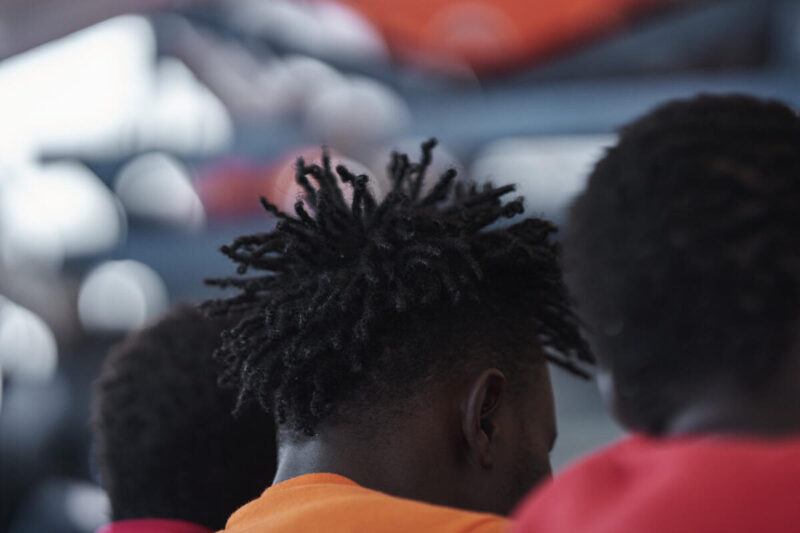
Raheem is 28 years old and fled Sudan.
*Name has been changed for protection
Every refugee has a story and a tale. I became a refugee from my homeland when the cries of our people grew louder in pain, and our children cried in sorrow over a fate that was destroyed, a future that was demolished, and development that was completely erased.
In Sudan, poverty, ignorance, and diseases spread across every inch of the land. This was the result of the power of weapons and bullets, accompanied by systematic ethnic cleansing that violated our land and our dignity, until the state collapsed and public services within state institutions disappeared entirely.
I decided to seek refuge in Libya. On my way there, the ground was my bed, and the sky was my blanket. I went searching for safety, only to find that the safety I was looking for did not exist. Instead, I experienced a live between refugee warehouses and Libyan prisons. In Libya, I found nothing but injustice, hateful racism, and filthy discrimination. Life there was extremely difficult; far more difficult than I had imagined while I was still in my homeland, or in the country I came from, Sudan.
In Libya, you cannot escape racist and regional slurs unless you choose a master for yourself. This means, quite literally, a system of slavery. A person must choose a master; only after doing so can one escape arbitrary arrests, imprisonment, and the abhorrent blows of racism.
During my time in Libya, my life was reduced to two possibilities: either I was thrown into prison, or I was held hostage by one of the Libyan militias. Either I had to pay an amount of money far beyond the capabilities of both me and my family, or I would remain a hostage. They used us as servants, moving us from one house to another, from one person to another. Otherwise, you would become a victim in their camps and military headquarters, whether of the army or the militia.
Many attempts to escape Libya
I decided to take the sea and migrate to Europe. The first time, we did not succeed. The second time, we did not succeed either. I was one of the African and Sudanese hostages held in militia prisons. We were beaten, tortured, humiliated, and subjected to every form of abuse, treated with brutality and barbarism by the Libyan authorities, or by the Libyan Coast Guard. We do not even know whether this was a a legitimate state authority.
From my perspective, any authority that takes us from the sea, leads us to military headquarters and prisons, holds us hostage, forces us to serve them in their military compounds for months or even years, and also forces us to work in their homes – from officer to officer, from general to general, from one person to another, selling us like goods, like commodities in a market, from one person to another – cannot be considered legitimate. In both attempts to cross the sea, the same cycle was repeated, with the same suffering.
In Libya I was subjected to violence, to beatings, and to every form of injustice and oppression in detention. I boarded another boat and headed out to the sea for a third time. I had decided that I needed to reach Europe – the place where human rights are known and where all components of society are respected regardless of differences in colour, religion, or ethnicity – and I would not stop trying. I decided that I must reach Europe, no matter the cost.
We found a vast and painful gap between what we had dreamed of and what we had expected, and what we encountered in reality among our Libyan brothers. We expected good treatment; instead, we encountered the worst forms of treatment. As a result, many brothers, many companions, and many friends – indeed, some of the dearest people we knew, whom we met in Libya and in its prisons – lost their lives at sea.
By the grace of God, I decided to take to the sea again. I boarded a boat for the third time, and after a short while we felt a sense of safety. That sense of safety, for us, meant only one thing: seeing a ship. It was the SOS Humanity rescue ship, the organisation that saved us from death.
Raheems Message to the EU
I also want to address a message to the European Union. I know very well that EU countries are the same countries that provide significant financial support aimed at fighting migration, preventing it, or stopping it altogether. But I also know that this is impossible. Migration is an issue, and issues require solutions. An issue cannot be solved without addressing its causes, its roots.
Today, migration is considered as one of the largest global issues, directly followed by the climate issue. Migration is one of the major global issues that requires fundamental solutions, not solutions based on violence, which is practiced by many of the very same actors who receive external funding to stop it. They practice violence and other forms of oppression against anyone who wants to migrate, or who wants to move from one country to another, or from one continent to another. I believe that the annual financial resources allocated and paid to these countries should instead be directed toward creating development projects in countries that suffer from poverty, disease, and illiteracy. This would be far better for the safety of future generations.
The money that is paid to authorities; especially the Libyan authorities, is nothing but further support for projects of extremism and terrorism, under the pretext of the legitimacy of the Libyan government, or under the claim that it is the legitimate government fighting migration. In my view, those who receive financial support from European countries cannot be considered a government at all. Rather, they are terrorist networks exploiting the name of the state, claiming that they are the ones managing the country and protecting it from migration.
How can it be justified that the Libyan Coast Guard takes a person, forces him to serve in military headquarters and private homes, trades him, and sells him from one person to another? If the detained person has a profession or a skill, he is exploited for human trafficking or sold in markets – markets resembling slave markets – passed from one person to another, from one employer to another.
All of this is happening now at the hands of the Libyan Coast Guard. I myself was detained for three months by the Libyan Coast Guard. They were the ones who transferred me from one person to another, forcing me to go with them to serve, to work in their homes, their companies, or wherever they wanted; many of the brothers experienced this as well.
One of the brothers who managed to escape the hell of Libya and whom I met by coincidence on this ship was exploited for eleven months, forced to serve them. The same happened to another friend, a brother from Pakistan, who was held for six months, and another person who was held for four months. All of this was for the benefit of the Libyan Coast Guard.
There is also the excessive violence used in prisons against detainees, including women detainees, who are subjected to sexual violence, physical violence, and rape. This also occurs in Tunisia, for example in the Tunisian city of Sfax, in southern Tunisia, where more than 37 cases of rape of African women were reported, committed by Tunisian authorities. These African women had fled there. Many people have seen the circulated videos showing what happened, as well as the testimonies broadcast by those who escaped that hell in Libya.
For all these reasons, I say that the money paid to these countries – whether Libya or Tunisia – will be misused, because they do not have legal institutions. Instead, they have militias, armed brigades, and terrorist headquarters. For this reason, we hope that the European Union will stop the support it provides, especially to Libyan militias.
These resources: ships, financial support, and other forms of assistance provided to the Libyan authorities are used to expand extremism and terrorism. Therefore, we hope that European authorities will stop this support in all its forms, so that they do not continue to support these actors.
We hope that instead of allocating funds to support such terrorist institutions, European countries will dedicate this money to development projects in poor countries; especially poor African countries suffering from war, poverty, hunger, illiteracy, and disease. This would be far better and far more noble than supporting militias in Libya or supporting the Janjaweed [Rapid Support Forces: RSF] in Sudan.


