Joint Statement: Reject the EU-wide list of ‘safe countries of origin’ – Tunisia is not safe
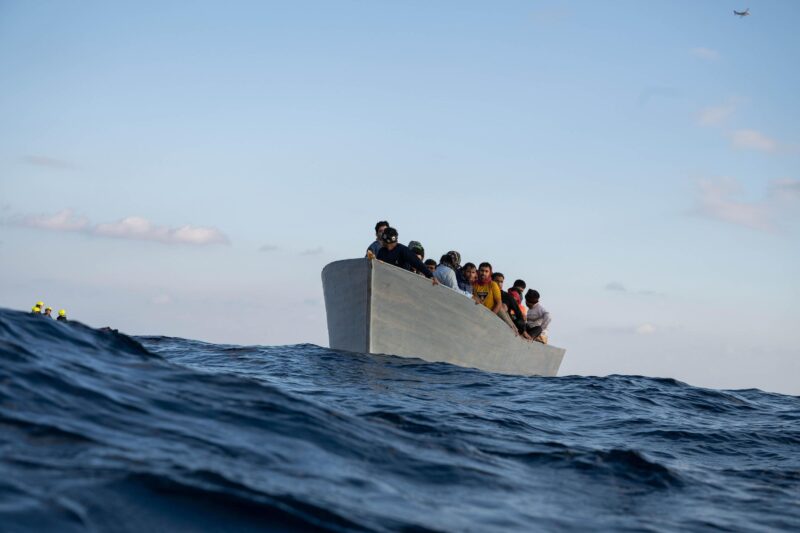
Ahead of the vote in the European Parliament on 10 February, we, the undersigned organisations, urge the Members of the European Parliament to reject the proposed EU-wide list of so-called ‘safe countries of origin’. This list is an instrument to deny access to protection and to legitimize violence and persecution in these countries. One cannot make a country safe by putting it on a list, as the example of Tunisia shows.
In view of the anti-democratic state transformation of Tunisia by President Kais Saïed; rampant repression against political opponents in Tunisia; the crackdown on civil society, judicial independence and the media; and gross human rights violations against migrants and refugees in Tunisia and Tunisian nationals, we, as search and rescue and human rights organisations, strongly oppose Tunisia’s inclusion on this list. We call for Tunisia not to be considered a safe place for people rescued from distress at sea, nor a safe country of origin.
Designating Tunisia as a safe country of origin fundamentally undermines the right to asylum and stands in stark contradiction to the human rights situation on the ground. It enables accelerated asylum procedures and illegitimate deportations, depriving Tunisian nationals of their right to an individual, fair, and effective assessment of their asylum claims, while giving the Tunisian authorities a renewed carte blanche to continue their systematic violations against migrants, civil society, and the wider civic space.
This designation represents a further extension of the European Union’s cooperation with Tunisia on border control and search and rescue: while implicitly treating Tunisia as a place of safety for people intercepted at sea and returned to conditions where their fundamental rights are not met, the EU now also seeks to declare the country safe for Tunisian nationals themselves.
Under EU law, a “safe country of origin” is defined as a country where, generally and consistently, there is no persecution, no risk of torture or inhuman or degrading treatment, respect for the rule of law, and effective protection of fundamental rights. In August 2025, the Court of Justice of the European Union clarified that such a designation must be based on up-to-date and reliable evidence, apply to the entire territory, and cannot ignore groups exposed to persecution or serious harm. While this interpretation will no longer be legally binding once the new Asylum Procedures Regulation including the EU-wide list becomes applicable on 12 June 2026 — thereby replacing the Directive framework — the judgment remains a crucial interpretative guidance for courts when reviewing the application of the EU-wide list, in particular with regard to evidentiary standards, legal certainty, and the effective protection of fundamental rights under the EU Charter of Fundamental Rights. Against this background, and in light of credible evidence of repression, discrimination and serious harm affecting identifiable groups in Tunisia, its designation as a safe country of origin cannot be sustained.
Over recent years, Tunisia has undergone a profound authoritarian transformation. Since 2021, President Kais Saïed has dismantled democratic checks and balances, ruled by decree, undermined judicial independence, and presided over a systematic crackdown on political opponents, trade unionists, civil society organisations, journalists, lawyers, and human rights defenders.
UN bodies, several international and local organizations, human rights defenders and lawyers have reported an alarming deterioration of civil liberties and fundamental rights in Tunisia, impacting both the migrant population and Tunisian citizens. Since 2021, the country has witnessed a significant rollback of human rights, characterised by a dismantling of institutional safeguards, an erosion of judicial independence and a clampdown on freedom of expression, association and peaceful assembly. A decree law from 2022 has been used to prosecute hundreds of citizens, specifically targeting opponents. In 2024 and 2025, the crackdown against perceived political opponents, civil society, and minoritised populations in Tunisia has further intensified, with civil society organisations being forced to cease their work, and mass trials against political opponents sentenced to 22-66 years of prison and even the death penalty for criticising the government.
These findings consistently demonstrate that Tunisia does not meet even the most basic criteria for being considered a safe country of origin. Ignoring these realities in the name of migration control is a grave political and moral failure.
Two sides of the same coin: “safe country” designation as continuation of EU externalisation policy
Despite extensive and well-documented human rights violations committed by the Tunisian authorities, the European Union and its member states have not only continued but substantially expanded their political, financial, and operational cooperation with the administration of President Kais Saïed. The aim is clear: no one should reach the EU at all costs. The proposed classification of Tunisia as a safe country of origin cannot be viewed without context. With this decision, the European Union continues its long-standing externalisation policies with Tunisia in the fields of border control, migration management, and search and rescue.
The cooperation culminated in the EU–Tunisia Memorandum of Understanding signed in July 2023, through which the EU pledged up to one billion euros, including significant funding for border and migration control. It has resulted in the outsourcing of search and rescue responsibilities to Tunisian authorities, including support to the Tunisian Coast Guard and the establishment of a Tunisian Search and Rescue Region, facilitating illegal interceptions at sea and returns to a country where fundamental rights are systematically violated.
This agreement was signed despite President Kais Saïed’s rhetorically racist statement from February 2023 ; despite Tunisia lacking a functional asylum system and
despite migrants and refugees having been forcibly expelled to border areas and the desert, violating the fundamental non-refoulement principle.
Classifying Tunisia as a safe country of origin extends this deterrence logic further. On the one hand, people are contained in Tunisia and prevented from fleeing, undermining their right to seek asylum (UDHR Art. 14(1)) and the right to leave any country, including their own (UDHR Art. 13(2); ICCPR Art. 12(2)). On the other hand, Tunisian nationals who reach Europe are denied meaningful access to asylum through accelerated procedures designed to facilitate rapid deportation. This is no protection policy; it is migration control disguised under the pretext of an asylum reform. It externalises responsibility, undermines the Refugee Convention, and makes the EU complicit in human rights violations instead of preventing them.

Our call to the European Parliament
As search and rescue and human rights organisations, we have been witnessing that the migration agreements made with Tunisia have proved costly in the past decade, leading to more human rights violations of refugees and migrants and more deaths at sea. Moreover, it makes the European Union dependent on authoritarian regimes and governments that can use migration as leverage for their own political interests.
In the background of this experience, we call on the European Parliament to uphold EU law, international obligations, and act in solidarity with people who have to seek protection.
We urge you to reject the EU-wide list of safe countries of origin. Tunisia is neither a safe country of origin for its citizens nor a place of safety for people intercepted or rescued at sea. Expanding presumption-based asylum tools will not reduce migration; it will instead undermine the fundamental right to asylum, accelerate violations of rights, increase dangerous escape routes, and deepen EU complicity in repression and violence.
Signatories:
1. Afrique europe interact
2. Alarme Phone Sahara
3. Alternative Espaces Citoyens (AEC)
4. Association nationale d’assistance aux frontières pour les personnes étrangères (Anafé)
5. ARCI
6. Baobab experience
7. Border Violence Monitoring Newtwork
8. borderline-europe Menschenrechtre ohne Grenzen e.V.
9. CCFD-Terre Solidaire
10. Collectif des Organisations de la Société Civile Sénégalaise (COSCE)
11. CompassCollective
12. EMERGENCY
13. European Center for Constitutional and Human Rights (ECCHR)
14. Federation tunisienne pour une citoyenneté de deux rives (FTCR)
15. Flüchtlingsrat Niedersachsen
16. Forum Tunisien pour les Droits Économiques et sociaux (FTDES)
17. IWATCH
18. KISA – Action for Equality, Support, Antiracism
19. MEDITERRANEA Saving Humans
20. migration-control.info project
21. Médecins Sans Frontières (MSF)
22. No Peace Without Justice
23. Pilotes Volontaires
24. PRO ASYL
25. Red Acoge
26. Refugees in Libya
27. Refugees platform In Egypt
28. RESQSHIP
29. Salvamento Marítimo Humanitario (SMH)
30. Sea-Eye e.V.
31. Sea Punks e.V.
32. Sea-Watch e.V.
33. Seebrücke
34. SOS MEDITERRANEE
35. SOS Humanity e.V.
36. TOM Tutti gli Occhi sul Mediterraneo
37. United4Rescue – Gemeinsam retten e.V.
38. Watch the Med AlarmPhone
39. World Organization against Torture (OMCT)


