SOS Humanity takes legal action against Italian ruling
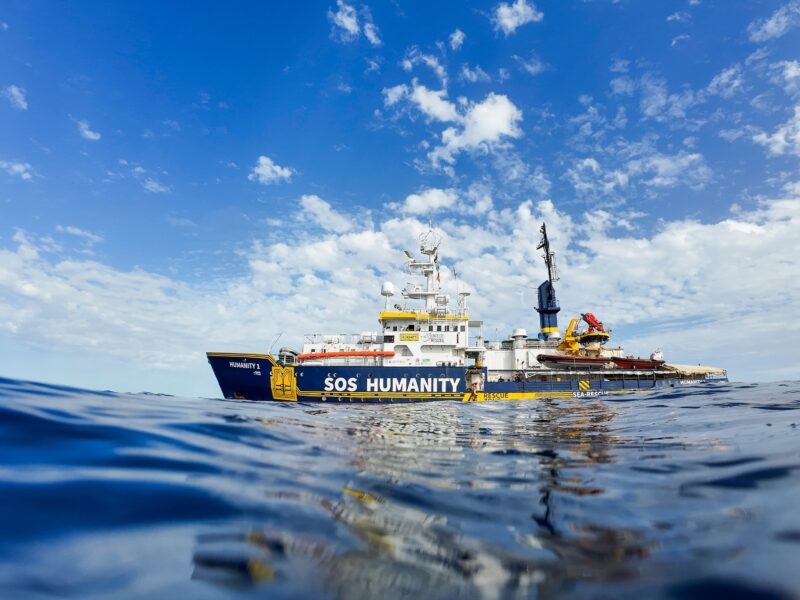
SOS Humanity is taking legal action following a ruling by the Regional Administrative Court of Lazio that stands in contrast to international law and Italian jurisprudence of the past 10 years.
On 19 February 2026, the Regional Administrative Court of Lazio issued its ruling on an appeal by SOS Humanity, filed in November 2022, against the Italian government’s inter-ministerial decree that led to a selective disembarkation. The Court dismissed SOS Humanity’s appeal on the grounds of its inadmissibility but still decided on the substance of the case, attributing the expenses of the trial of 2,000€ to SOS Humanity. The decree regulated the entry into and stay in Italian territorial waters of the vessel Humanity 1, which had carried out rescue operations of persons in distress in the Mediterranean Sea. Subsequently, Humanity 1 was ordered to leave the port of Catania with 35 survivors remaining on board. Previously, authorities conducted an arbitrary triage of survivors in the port of Catania in violation of international law, concluding that 36 survivors would not be allowed to disembark as they allegedly did not find themselves “in a precarious health situation”. SOS Humanity will take legal action against the decision.
“The decision raises serious and urgent concerns because it effectively ignores the presence and rights of people who are in distress. It reverses the established order of constitutional principles by placing less important interests above fundamental rights, which are supposed to have priority. By departing from well-established legal rules, the ruling risks enabling States to avoid their responsibilities. As a result, vulnerable people at sea may be left without protection, and the overall respect for the rule of law is weakened.” says Giulia Crescini, lawyer of SOS Humanity.

The Court substantiates its decision by weakening the guiding legal principles of search and rescue and humanitarian work at sea. It dismisses Italy’s responsibility as search and rescue authority to coordinate a Place of Safety for people rescued from distress at sea and outsources this responsibility to Malta and Tunisia, even though the Maltese Rescue Coordination Centre has been proven systematically dysfunctional in responding to distress case since over ten years, and Tunisia does not constitute a Place of Safety. Moreover, by classifying Humanity 1 as a case of non-innocent passage, framing persons rescued from distress as violating Italian immigration laws, the decision contradicts the most basic principle of international maritime law: that persons must be rescued and disembarked in a place of safety regardless of their legal status, nationality, gender, or age. Confusing the disembarkation of people rescued from distress with an attempt to violate immigration laws is a misrepresentation that conflicts with binding law principles.
The ruling stands in stark contrast to current Italian jurisprudence. In February 2023, the Civil Court of Catania had already declared that preventing the 35 survivors from disembarking under the decree was unlawful as it hindered the duty to disembark in a place of safety, and the right to access an asylum procedure. The Italian Supreme Court (Court of Cassation) – in the case of Rackete case in 2020 and Open Arms in 2024 — made clear Malta and Tunisia cannot be considered Places of Safety and reaffirmed that coastal States must ensure that people rescued at sea are brought to a Place of Safety. This ruling sets a dangerous legal precedent by curtailing ships’ right to free passage and their duty to rescue. Instead of strengthening international maritime law and human rights protections, it risks legitimising European states’ avoidance of their responsibilities toward people in distress. This comes at a time of the highest number ever recorded of deaths in the Mediterranean for January and February, and the right-extremist Italian government is discussing a new naval blockade.
Background: events in November 2022 related to the ruling
On 4 November 2022, after 13 days at sea with 179 survivors and 21 requests for a place of safety to Italy and Malta to disembark the survivors who had been previously rescued from distress at sea by the rescue vessel Humanity 1, the vessel received an inter-ministerial decree signed by the Italian Ministers of Interior, Defense and Infrastructure. The decree prohibited the vessel from stopping in Italian territorial waters longer than is “necessary for rescue and assistance operations for people in emergency conditions and in precarious health conditions.”
On 5 November, Humanity 1 was ordered by the Italian Ministry of Interior to enter the port of Catania, where 36 of the 179 survivors were denied disembarkation based on an arbitrary and illegitimate assessment by authorities classifying them as healthy. De facto, this was applied to all adult male survivors. One of the 36 people lost consciousness, collapsed, and had to be picked up by an ambulance after the decision was announced. Thereafter, the vessel was ordered to leave the port of Catania, in violation of international maritime law, which establishes that a rescue is completed only after survivors are disembarked in a place of safety. On 8 November, all 35 remaining survivors were able to disembark in Italy.
SOS Humanity supported an urgent application filed by the 35 survivors before the Civil Court in Catania, who had not been authorised to disembark, seeking immediate access to a place of safety and the possibility to apply for international protection. The Civil Court found that preventing the rescued people from disembarking at a safe place and from accessing the asylum procedure based on the decree was unlawful.
On 6 February 2023, the court of Catania ruled that the decree imposing a ban on the rescue ship Humanity 1 on November 4, 2022, was unlawful, as it discriminatorily hindered the right to disembark in a place of safety and access an asylum procedure. Nevertheless, displaying a fundamental inconsistency with previous jurisprudence, on 19 February 2026, the Administrative Court of Lazio ruled on the merits in favour of the inter-ministerial decree, despite declaring the case as inadmissible. SOS Humanity will appeal to the ruling.


