Lawless Battleground – Increased Violence at Sea by Multiple Actors
For over a decade, the Central Mediterranean has been one of the world’s most lethal migration route, with at least 23,249 people confirmed to be dead or missing at sea between 2014 and April 2026, while the number of unrecorded shipwrecks and deaths remains high. A significant body of research, including from the United Nations, has in part attributed the lethality of this route to the policies of the EU and EU Member States, in particular: the absence of safe and legal migration routes, withdrawing from search and rescue in the biggest part of the Central Mediterranean Sea, obstructing non-governmental search and rescue efforts, and outsourcing border control and search and rescue to Libyan and Tunisian actors who systematically violate international law.
In recent years, an escalation of systemic violence at sea committed by multiple actors has been reported in the Central Mediterranean by search and rescue organisations and other experts and witnesses. The search and rescue NGO Sea-Watch documented 60 violent incidents at sea by Libyan actors in the period 2016-2025. Although aggressive and illegal behaviour toward humanitarian actors, is well documented, people seeking protection bear the brunt of this escalating violence from EU-funded security forces and unidentified actors. The increasing violence and lack of accountability reflect a breakdown of the rule of law in the Central Mediterranean, turning it into not only a mass cemetery but also a lawless battleground. The high risk of crossing the Mediterranean is exacerbated by this violence. As perpetrators are not held to account, violence becomes a tool of migration control. By legitimising violence at sea and criminalising humanitarian action, the EU and its Member States are not only undermining international law but also reversing its order.
Various actors commit violence against people on the move and humanitarian actors: recognisable state or state-affiliated actors such as border guards, police, and militias; and unidentifiable actors that could be part of militias or facilitators, commonly labelled as smugglers (consensual, paid facilitation of irregular border crossings) and traffickers (non-consensual or coercive, exploitation-based).
Violence at Sea by EU-funded State Actors
Significant reporting exists of violent actions by EU-funded security forces – particularly the Tunisian Coast Guard, the so-called Libyan Coast Guard (scLCG), actors associated with the Libyan General Administration for Coastal Security (GACS), militias who are involved in human trafficking aligned to both the internationally recognised Government of National Unity (GNU) of Libya, and the unrecognised administration in Eastern Libya.
In the period of 2016- April 2026, the EU-backed so-called Libyan Coast Guard intercepted and illegally pulled back 192.182 persons from distress at sea. The UN Investigation Mission 2023 found that the so-called Libyan Coast Guard was also responsible for committing grave human rights violations in detention centres, which amount to crimes against humanity. And UN experts highlight that members of the so-called Coast Guard engage in human trafficking for financial benefits. These facts have been confirmed also by unnumerable accounts by survivors documented by the crew of our rescue ship Humanity 1 whose testimonies SOS Humanity collects systematically.
Since 2023, illegal interceptions on the route from Tunisia have also risen, which has led to an alarming increase in violence. According to Amnesty International and Human Rights Watch, multiple testimonies by people on the move describe the interceptions by the Tunisian Coast Guard as dangerous and reckless, jeopardising lives. Persons being forced back to Tunisia were subsequently tortured and mistreated. Documentation of violence by state actors include shootings at NGO ships and boats in distress, incidents involving the deaths of migrants, hijacking of rescue ships, intentionally performing dangerous manoeuvres and chasing boats in distress, hindering rescues, threatening rescue crews, beating persons in distress, using tear gas or electric shock against people in distress, removal of engines, cases of torture and theft of money and belongings, forced illegal interceptions and refoulement, and abandoning dead bodies at sea.
The described violence equally applies to the route from Libya. A peak of violence against humanitarian workers was reached on 24 August 2025 when the rescue ship Ocean Viking was attacked in international waters while carrying 87 survivors of distress cases, with hundreds of bullets of live ammunition fired at the ship by a so-called Libyan Coast Guard patrol vessel, previously provided by Italy under EU funding. This was unprecedented in its ferocity but part of a long pattern of similar aggression witnessed and experienced by NGO ships from a wide range of identified and unidentified actors in international waters north of Libya. To date, no measure has been taken by the EU to investigate the events.
Threatening and using violence against people in distress at sea is completely opposed to the actual duties of a coast guard. When directed at humanitarian ships, it poses an increased security risk to the rescue mission and violates the fundamental principle of freedom of navigation, which applies to all ships in international waters (Art. 87 UNCLOS). Submissions awaiting investigation have been made to the International Criminal Court against officials of the European Union and its Member States due to their complicity in crimes against humanity committed against refugees on the Central Mediterranean route (2014-2020).


Violence at Sea by Unidentified Actors
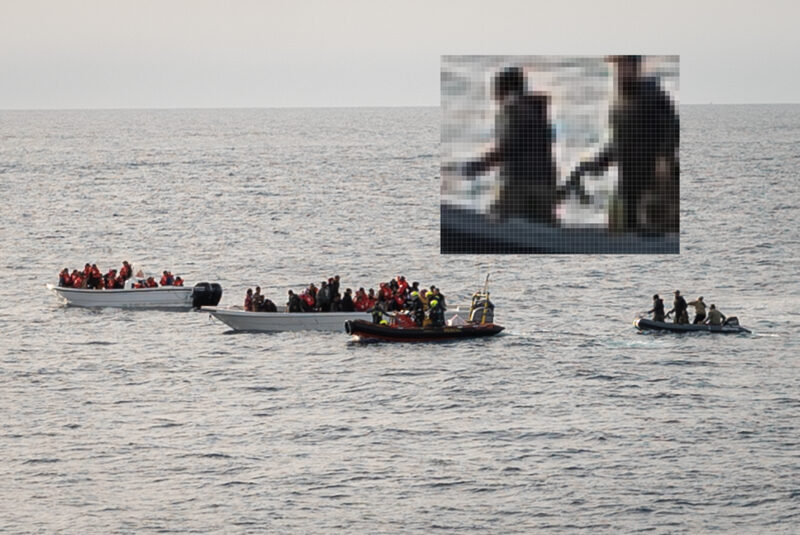
Violent incidents by unidentified actors have also been widely documented, with no measures taken by authorities to pursue investigations and hold perpetrators accountable. For years, SAR NGOs and other experts have increasingly reported distress cases involving small fast boats with powerful engines, carrying people in overcrowded conditions, in unseaworthy boats, and lacking lifesaving equipment. They approach NGOs from the south, and when assistance is rendered to people in distress, one or more people on board refuse it and leave the scene after everyone else has been taken on board the rescue ship. The incidents mostly occur north of Zuwara and Tripoli in international waters (in the search and rescue region nominally assigned to Libya).
Scenarios differ in character: cases include persons refusing to be rescued who remain on board and leave the scene heading south, small fast boats engaging in hazardous manoeuvres near distress cases and collecting empty boats after rescue operations by NGOs, masked persons forcing people in distress into the water, and direct approaches to rescue scenes by fast boats in distress manoeuvring at speed, aiming to swiftly transfer people to the rescue vessel. The boats in question are often heavily overcrowded and are not equipped with rescue equipment such as life jackets.
During most of these incidents, the persons who leave the scene cover their faces, in some cases, individuals were observed filming during the incident, and in others, they were armed and issued threats at gunpoint. These cases, which often involve dangerous manoeuvres close to rescue scenes, pose a number of risks to protection seekers and search and rescue NGOs. People in distress face serious threats to their life and physical safety, including the danger of falling or being pushed into the water, as well as exposure to violence or being compelled to undertake hazardous embarkation attempts, such as climbing onto large rescue vessels from unstable, moving boats. At the same time, search and rescue actors themselves encounter considerable dangers, including harassment from external actors, the need to perform risky manoeuvres, and the technical complexity of rescue operations under unstable conditions.
In addition to these physical risks, there are profound legal and political challenges: individuals in distress are frequently subjected to false accusations of involvement in smuggling, while rescuers carrying out their duty may later face allegations of collusion with those responsible for unsafe transfers or responsibility for endangering protection seekers, creating a climate of uncertainty and potential criminalisation for both groups.
The System of Lawlessness behind Violence at Sea
According to experts, these manoeuvres by unidentified actors correspond to a strategy of adaptation to a broader system of lawlessness, including both EU border externalisation and Italian criminalisation measures. Rebecca Solovej, PhD fellow at the Department of Anthropology, University of Copenhagen explains:
“Research on migration across the Mediterranean Sea has well-documented the fact that counter-smuggling initiatives and border enforcement push those who facilitate migrants’ journeys to opt for more dangerous routes and strategies in order to avoid criminalisation. At the same time, migrants who cross the Mediterranean sea do so because they have no access to safe and legal pathways into the EU’s asylum system, meaning they must rely on smugglers to facilitate their journeys. When unidentified actors perform risky and deadly maneuvers around rescue vessels, these dangerous strategies are likely a response to such overlapping border enforcement dynamics”
Moreover, unidentified perpetrators responsible for dangerous behaviours at sea are not always separate or opposed to recognised state actors; in Libya, as in many other places, they are often interlinked. Multiple reports explain how Libya’s weak central governing institutions enable smuggling and trafficking to thrive as legitimate industries, with official coastal authorities cooperating with armed groups and involving criminal elements.
Search and rescue NGOs have informed Italian authorities about these cases via emails, phone calls, and reports, highlighting the risk to life and limb of people in distress and to the safety of responders. They have also attempted to draw attention to the increased number of these cases through media and advocacy work. Yet EU member states never acknowledged the multiple demands to stop collaborating with these actors. As a response, they have pursued a political line of counter-smuggling and counter-trafficking targeting protection seekers and humanitarian workers, while actually providing financial support and enabling conditions to smuggling and trafficking actors who engage in violent behaviour at sea.
Based on SOS Humanity’s own calculation, the EU will have provided funds of over 234 million € to Libya and Tunisia for border control, including funding for rescue coordination centres and coast guards in the period 2017-2028. By financing these forces, which are well-known for their indiscriminate use of violence and for being involved and working closely with smuggling and trafficking, the EU and its member states make themselves complicit in the system of abuse and exploitation. The violence that people on the move have systemically faced in the Central Mediterranean Sea, and which has escalated against search and rescue NGOs, is a direct outcome of the EU policy of sustained support to the actors responsible, and of the lack of safe routes. When states criminalise both movement and the facilitation of movement, they create the conditions in which violence and abuses of power become systemic. Public policy, not abstract conditions, produces increasing violence at sea.
SOS Humanity Demands to Establish Safety at Sea
This violence poses serious risks to the lives and limbs of people in distress, the safety of search and rescue actors and the legal and political security of both people migrating and humanitarian actors. To reduce the risks of dangerous sea crossings and re-establish the rule of law, we demand:
- Effective humanitarian coordination of maritime distress cases. This would involve implementing the Mare Solidale proposal of an EU-coordinated international search and rescue mission, and extending the depth of operations of coastal states. This would ensure distress cases are responded to whilst deterring violent and illegal behaviour. In the interim, states should deepen coordination with SAR NGOs.
- End EU-support for Libyan maritime “security” actors. Dangerous behaviour, abuse, and significant widespread human rights violations have been attributed to Libyan forces that currently operate with EU support and coordination. Moreover, reasonable evidence links militias involved in dangerous transfers and smuggling and/or trafficking more broadly to Libyan security forces. By continuing to fund, coordinate with, and legitimise these forces, European actors are complicit in sustaining a system of abuse, exploitation, and denial of safe pathways to protection.
- End EU-support for Tunisian maritime actors. Tunisian forces systematically jeopardize live and limbs of persons in distress at sea and bring people back to Tunisia, where Tunisian security forces systematically persecute and abandon protection seekers in the deserts, while collaborating with trafficking actors. By continuing to fund, coordinate with, and legitimise these forces, European actors are complicit in sustaining a system of abuse, exploitation, and denial of safe pathways to protection.
- End criminalisation of protection seekers and humanitarian workers. Criminalisation of people seeking protection and humanitarian workers under “anti-smuggling” is hypocrisy in the face of supporting actors directly involved in human trafficking systems and undermines the right to asylum and international law.
- Enable sufficient safe and legal routes to reduce the necessity of people making dangerous crossings to exercise their right to claim asylum. Thereby, risks at sea and the reliance of people seeking safety on smuggling networks can be reduced.


